The next journey begins Poland and Rwanda 2019

The next journey begins  Poland and Rwanda 2019
2019 adventures

Sunday, August 4, 2019

Belgian Memorial


Carl and Johnson reminicing

The drain where Johnson saw a man shot and blood flow

Window where Johnson could see Carl

Kids at a program for at risk kids

art work 


Carl and Dumas brothers forever


Johnson 


the last day of this reemarkale journey

Yes hard to believe it is the last full day, wehave bonded, cried, laughed and had experiences that will take months to absorb,

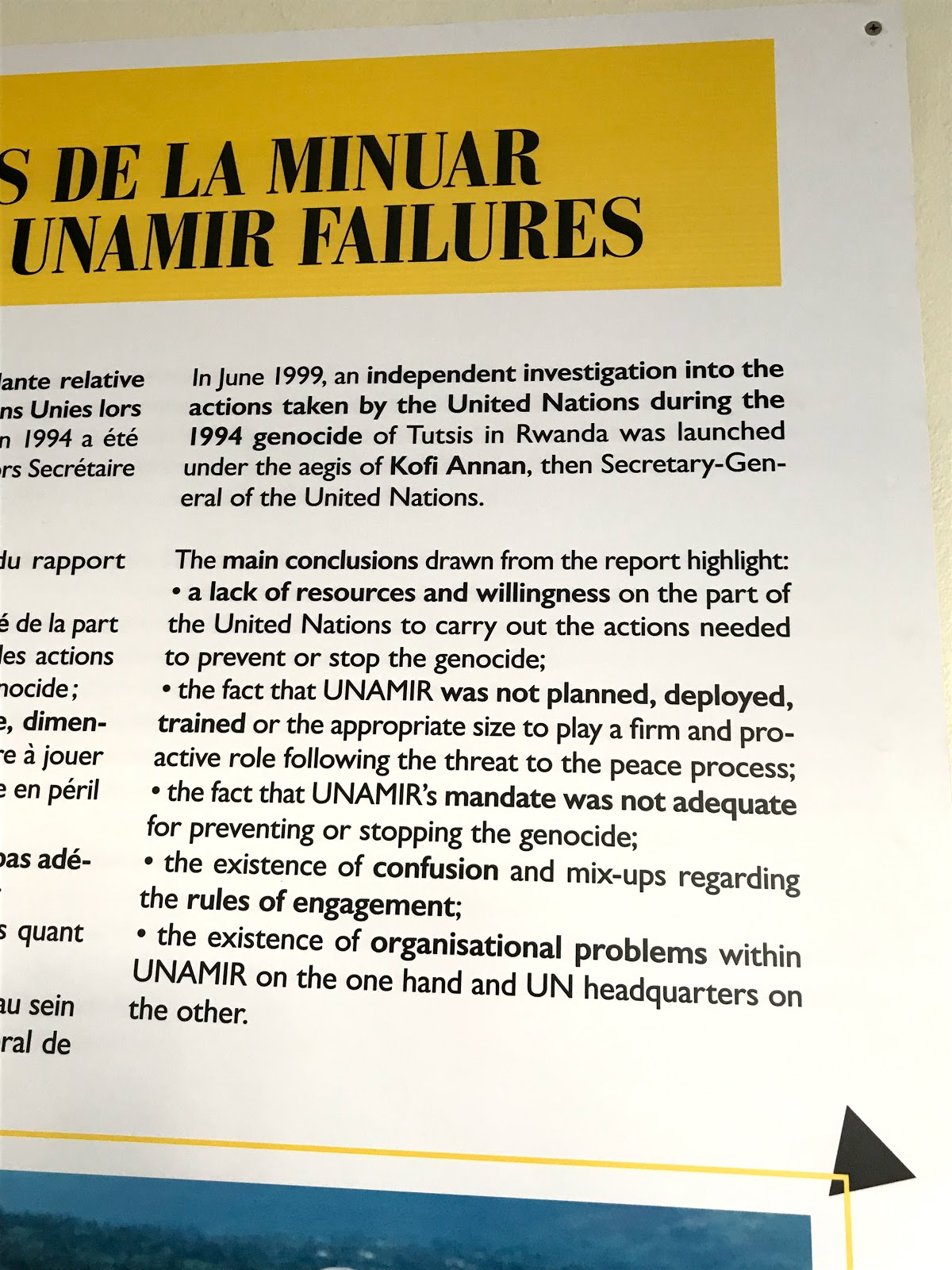
We began at the Belgian soldiers memorial. The site where the Genocidal troops murdered 10 Belgian soldiers. The memorial explains it all in a well done time line and the memorial is quite moving. You can google it if you want details or read the photos I took of the timelines.  The bullet holes are real, and inside you can se where in the corner of the room  the murders took place in a barrage of bullets

After that we visited a little crafts market for more shopping and finally head to Gisimba orphanage. Which now is an after school facility as well as a center for foster children.  The foster system is quite different. One can foster a child either in simple or life time way. Simple is up to 18 then te child is on their own, Or fully vested as part of a family, People receive no money for fostering, And childre may be removed if abuse or child labor is evident.  Tje after school programs include, art, jewerlry making, theater, sports etc. Primary school age kids get free breakfast.

This is where Johnson  lived after surviving the genocide.  At 9 he watched as his moher was gunned down, and did not know until a cosi saw him that is father was also killed. Johnson is working on his memoir.  He is engaged to a lovely girl and I wish him so much love and hope.  He showed me where he slept and wold see Carl outside his window. Carl was on top of a water tower and would bring in supplies when he could, often at his own peril.  Johnson and Carl mat for the first time after the genocide in 2011 and Johnsn explains in Rwandan culure  as in most) men do not cry and he cried like a baby when he reconneced wth Carl.  Carl literally saved the over 400 people in the orpanage, single handedly. He confronted the Interhamwe ( militia) face to face and is so humble about what he was able to do. His book is called :Im not Leaving"

The director of the school is Dumas Gisimba who aslo served as a judge for the Gacaca tribunal. He spoke about Robert Kajuga who was actually a Tutsi and gave the order on the radio for the massacre to begin. 405 people were hiding in the orphanage. Dumas said the killers wre scared of dieing bt not of killing. When asked how he can preside over case after case of people who killed his own neighbors, their neighbors and families. he said ' Pardon has no borders and has no frontiers'
Carl worked wit him  to insure the safety of those at the orphanage. Johnson told me how he saw the friendly cook of the orphanage get shot ad saw his b lood running down the stret exactly where we are standing.  A few yers ago a few of the children that were saved along with their own children suprised Carl with a party and a painting. Iheard it was an undescribably moment.
A lot of this can be found on line or watch Ghosts of Rwanda and sometime in April also a good movie.

So next blog will be a reflection once home


Friday, August 2, 2019

TIG camps

This was actually yesterday but I was too tire to post and am equally tired now after 17 hr safari day. But I wanted to post about our day wit the National Unity and Reconcilitatin Commission and the TIG camps.

We met with Ndayisaba Fidele, who is the executive secretary of this commission
He began with an in depth history of Rwanda and its neighbors, its colonial years and the genocide in 1959 and then again 1994. I will not go into all the history here as it can be read on line.
This program supports resorative justice.  All the cases of genocide were tried by he Gacaca ( similar to Nurenberg trials) The cases of genocide were taken to the community. 1,958,000 cases. In 1995 120,000 suspects were in prison and it would have taken over 100 years to try them all in traditional courts. 
Suspects that confessed and apologized receive reduced sentences and may became part of the TIG camps.  We visited one yesterday. The inmats wear blue as opposed to general population inmates in orange,  The Rwandan correctional facility is in what appears to be a village. The guards carry no weapons and appear to interact in a postive way with the inmates . The idea for this type of incareration was introduced in 2011 but the President finally agreed in 2015. TIG means work in the interest of the general population. the program based onn Reinvnt yourself.  The philosophy is that everyone can change.  The directer, Janaibu previously worked i the UN. There are 4 TIG camps today, This wone began with 1000 and today have 69 left which means they served their time and have apologized. there are 51men and 18 women here, Of this 16 men and 15 women are there for genocidal crimes. The remainder are there for other crimes.  Some of the people may have actually used machettes and others may have collaborated. We did not ask.

The inmates work for the community- building housing, making roads.  They ae free to come and go and after 1 year can go to visit their familes- without superevision. Often victims come on Sunday actuallu to visit the inmates who, in some cases have killed their families.
We asked them what they want us to tell the youth iin America and one replied tell them not to get trapped. The perpertrators told them they would live a good life if they killed the others- look at where are are now. They also apoke about not segragating and if even a teacher teaches this you must no agree to making divisions. They mentioned how the new President-- whom is well loved- was taught well.President Kagame.

The inmates greeted us with song- itmeant we can change, The guardstruly believe ALL people change. They are proving it and also the victims are doing what I think is the impossible- forgivness
The little boy is the son of one of the guards


safari day Parc National de l Akagera